The Leak Ladder: The Complete Guide
The step-by-step financial priority order that tells you exactly what to fix first. 9 rungs. One at a time.
 Joy Casfhir·13 min read·Published Mar 23, 2026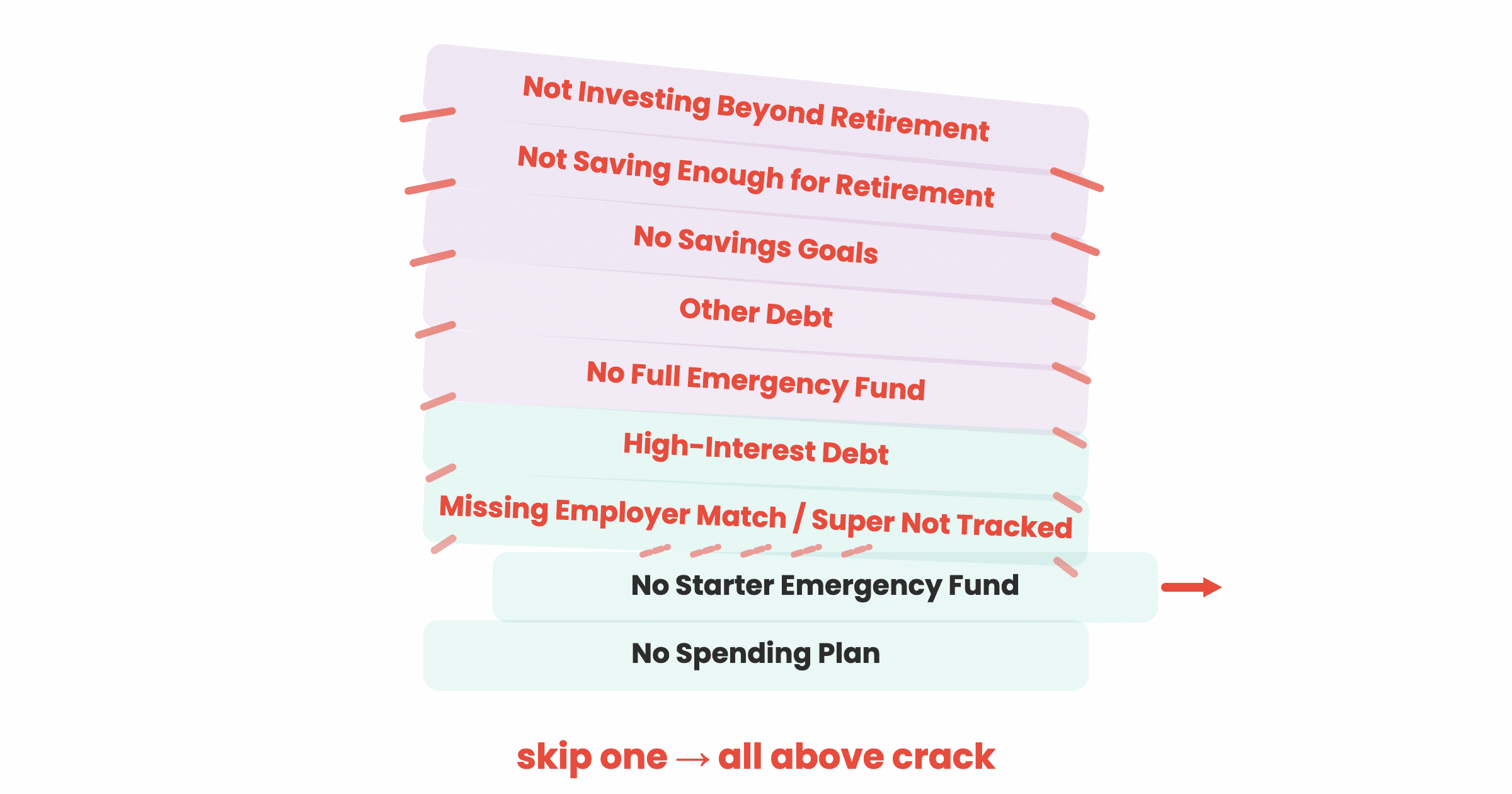
Most personal finance advice is a list of good ideas in no particular order. Save more. Invest early. Pay off debt. Build an emergency fund. Start a retirement account.
All of that is technically correct. And all of it is useless without knowing which one to do first.
Because the order matters. Do them out of order and you end up undoing the good stuff you already did. Pay off debt before you have any emergency savings, and one car repair puts you right back in debt. Invest while carrying credit card debt at 18%, and you're mathematically losing money every month.
The Leak Ladder fixes this. It gives you the exact priority order. Step by step. One rung at a time.
Where This Comes From
I got the idea of doing things in a specific order from the r/personalfinance community. The Leak Ladder is my version of that: a system that detects which rungs you're missing, tells you what to fix next, and adapts when life gets in the way.
How the Ladder Works
There are 9 rungs. Each rung is a financial leak: something in your setup that's quietly costing you money.
You start at the bottom and work up. You don't skip rungs because each rung protects the ones above it. If you build wealth (top of the ladder) without a safety net (bottom of the ladder), one emergency pulls everything down.
Some rungs can run in parallel. Some get paused until you handle the ones below. I'll explain which is which as we go.
Rung 1: Get a Spending Plan
The leak: No Spending Plan Why it's the foundation: Without visibility into where your money goes, every other leak is invisible. You can't fix what you can't see.
A spending plan doesn't have to be complicated. It's not about restricting yourself. It's about knowing where your money goes so you can make intentional choices instead of wondering at the end of the month why there's nothing left.
The simplest version: every time you get paid, decide where the money goes before you spend it. Income comes in, every dollar gets assigned. The goal is to get your unassigned money to zero, meaning every dollar has a purpose before you spend it. Not zero in your bank account. Zero dollars without a job.
If you've tried budgeting before and quit (most people have), the problem probably wasn't the concept. It was the tool. There's a whole article on why budgeting apps fail if you want to go down that rabbit hole.
When you're done: You have a spending plan that runs on your pay cycle. You know where your money goes each time you get paid. Move up.
Rung 2: Build a Starter Emergency Fund
The leak: No Starter Emergency Fund The target: $1,000 (or local equivalent)
This isn't the full emergency fund. That comes later. This is the floor under the floor.
The reason it's only $1,000: if you have high-interest debt (next rung), you don't want a large pile of cash sitting in savings earning 0.5% while your credit card charges you 18%. But you also can't have zero buffer, because one unexpected expense without savings means new debt. The $1,000 is the minimum buffer that keeps you from going backwards while you attack debt.
If you have no debt at all, you can skip ahead to the full emergency fund (Rung 5). But most people have some form of debt, so this rung exists for them. The system shows you one or the other, never both at the same time. If you have high-interest debt, it prioritizes the starter fund. Once the debt is cleared, the full fund appears.
When you're done: You have $1,000 set aside that you do not touch unless it's a genuine emergency. Move up.
Rung 3: Collect Your Free Money
The leak (US): Missing Employer Match The leak (AU): Super Not Tracked
This rung looks different depending on where you live, but the principle is the same: there's money available to you that you're not collecting.
If You're in the US
Your employer probably offers to match a percentage of your retirement contributions. If you're not contributing enough to get the full match, you're turning down free money.
Here's how it works: say your employer matches 50% of your contributions up to 6% of your salary. If you contribute 6%, they add another 3%. If you only contribute 3%, they add 1.5%. That gap is the leak.
Even $50/month of uncollected match, compounded over a 30-year career, adds up to tens of thousands of dollars. This is guaranteed return. Higher than any investment. Higher than any debt interest rate. It's literally free.
The fix is straightforward: find out what your employer matches (every employer's formula is different, so check your benefits portal or ask HR), and contribute at least enough to get the full match. Not more (that's a later rung). Just enough to collect what's being offered.
If You're in Australia
Super contributions are mandatory. Your employer already contributes 12%. So the leak here isn't about matching. It's about tracking.
If you've changed jobs a few times, you probably have multiple super accounts. Each one charges fees. Some have duplicated insurance. And roughly 4 million Australians have two or more accounts without realising it. There's nearly $19 billion in lost and unclaimed super sitting in accounts people have forgotten about.
The leak: you don't know how much super you actually have, or how much of it is being eaten by fees across multiple accounts.
The fix: log into myGov, check your ATO online services, and see how many super accounts you have. If there's more than one, consolidate. You can do this through myGov in about 10 minutes. That's 10 minutes to potentially save thousands in duplicated fees over your career.
When you're done: You're getting your full employer match (US) or you know exactly where all your super is and it's consolidated (AU). Move up.
Rung 4: Kill High-Interest Debt
The leak: High-Interest Debt (anything at or above 7% APR) Common culprits: Credit cards, personal loans, buy-now-pay-later, payday loans
This is the leak that actively works against everything else. While it exists, it's compounding against you. Every dollar you invest while carrying debt at or above 7% is a dollar that would do more work paying off the debt. The long-term market average is roughly 7-10%, so if your debt costs more than what the market would give you, paying the debt IS the best investment.
Two approaches that work:
Avalanche method: Pay off the highest interest rate first. Mathematically optimal. Saves you the most money over time.
Snowball method: Pay off the smallest balance first. Psychologically rewarding. Gives you quick wins that keep you motivated.
Which one should you pick? Honestly, whichever one you'll actually stick with. The math favours avalanche. The psychology often favours snowball. Both are better than the default, which is making minimums on everything and not having a plan.
The non-negotiable rule: always pay minimums on ALL debts. Then direct extra money to your target debt (highest rate or smallest balance, your call).
Important: While you're on this rung, some higher rungs get paused. There's no point increasing retirement contributions while high-interest debt is eating you alive. The system knows this. Clear the debt first, then the higher rungs unlock.
When you're done: All debt at or above 7% APR is gone. The relief is real. Move up.
Rung 5: Build the Full Emergency Fund
The leak: No Full Emergency Fund The target: 3-6 months of essential expenses. Variable income? Aim for 9-12 months.
Now that the high-interest debt is gone, it's time to build the real safety net.
This fund exists so that when life happens (and it will), you don't go back into debt. Job loss, medical bills, car breakdown, housing emergency. Without this fund, any of these sends you back to Rung 4.
The math: add up your essential monthly expenses (rent/mortgage, food, utilities, transport, insurance, minimum debt payments on any remaining low-rate debt). Multiply by 3-6. That's your target.
Don't overthink the number. If 3 months feels scary, aim for 6. If your income is unpredictable (freelance, seasonal, commission-based), aim for 9-12. The point is a buffer that lets you handle disruptions without reaching for a credit card.
When you're done: You could survive 3-6 months (or more) without income. That's a level of security most people never reach. Move up.
Rung 6: Handle Other Debt
The leak: Other Debt Common culprits: Student loans, car loans, lower-rate personal loans
This is debt that's not high-interest but still has a balance and a monthly payment. It's not an emergency the way credit card debt is, but it's still a hole in the bucket.
The approach here depends on the rate. Everything under 7% APR lands in this category, but there's a range:
- Below 4%? You can make a case for just paying minimums and directing extra money to higher rungs (retirement, savings, investing). Your money almost certainly does more work elsewhere.
- Between 4-7%? It's a judgment call. Some people want to be debt-free as fast as possible. Others prefer investing. Both are valid.
If a debt is sitting just under 7% and it's stressing you out, treat it like high-interest anyway. The psychological cost of debt matters too.
If you're in Australia: HECS / HELP debt
HECS/HELP debt lives on this rung too, and for most people it's the least urgent thing on it. The reason is that HECS isn't charged a real interest rate. Each June, the balance gets indexed to the lower of CPI or the Wage Price Index (WPI), whichever one is smaller that year. This cap was brought in by late-2024 legislation, specifically so HECS debts can't grow faster than wages (it was retroactively applied to 2023 indexation, where the original 7.1% rate was adjusted down to 3.2%).
So yes, your balance does grow a bit each year. But it grows with inflation or wages, not via compound interest the way a credit card does. Over time this keeps the real value of the debt roughly flat. That's very different from a credit card or a personal loan, where the balance compounds against you at a fixed rate no matter what the economy is doing.
What that means in practice: the compulsory repayments that come out of your pay each period are usually enough. Extra voluntary payments don't save you interest the way they would on normal debt, because there isn't any interest to save. In most cases, any spare money is better off going to higher rungs like retirement contributions, savings goals, or investing.
There's one narrow exception. If you're sitting just below a compulsory repayment threshold and a pay rise is about to push you into the next bracket, a small voluntary payment to drop your balance below the bracket can be worth it. That's a specific, situational move though, not a general strategy. For everyone else, the simplest approach is to let HECS do its thing through the compulsory repayments and put your attention on the rungs where extra dollars actually move the needle.
If you genuinely want to be HECS-free for psychological reasons, that's a valid choice too, the same way someone might want to clear a low-rate car loan just to not have it in their life. But from a pure "where does each dollar do the most work" standpoint, HECS is near the bottom of the priority list.
Back to the general principle
This rung is more flexible than the others. The right answer depends on your rates, your risk tolerance, and how much the debt bothers you psychologically. Some people sleep better debt-free, even if the math says they'd earn more investing. That's a valid reason.
When you're done: You either have no remaining debt, or you have a plan for the low-rate debt that you're comfortable with. Move up.
Rung 7: Set Savings Goals
The leak: No Savings Goals
This rung is different from the others: it's never paused. You can work on savings goals at any point on the ladder, even while handling debt.
Why? Because savings goals are about building the life you want, not just fixing what's broken. A holiday, a car upgrade, a house deposit, a wedding, a move to a new city. These goals keep you motivated while the structural stuff gets sorted.
The key is having an actual plan with a number and a timeline, not just a vague "I should save for a house someday." How much do you need? By when? How much per pay cycle gets you there?
When you're done: You have defined savings goals with amounts, timelines, and a plan to hit them. This one is ongoing.
Rung 8: Save for Retirement
The leak: Not Saving Enough for Retirement The target: 15-20% of gross income going toward retirement
If you're still carrying high-interest debt, this rung is paused. That's by design. There's no point optimising retirement contributions while debt is compounding against you at a higher rate. Clear the debt first, then come back to this.
Once you're here, the goal is straightforward: get your total retirement contributions (including employer match or super) to 15-20% of your gross income.
In the US, the priority order is usually:
- Contribute enough to get your full employer match (Rung 3, already done)
- Max out IRA contributions
- Increase employer-sponsored plan contributions toward the 15-20% target
In Australia, your mandatory super (12%) gets you most of the way there. But if you want to boost it further, voluntary concessional contributions (like salary sacrifice) are taxed at just 15% inside the super fund, which is lower than most people's marginal tax rate. So you pay less tax AND grow your retirement faster. The concessional contributions cap is $30,000 for FY26 (rising to $32,500 from July 2026), and that includes your employer's contributions.
If 15-20% feels impossible right now, start where you can. 10% is better than 5%. 5% is better than nothing. The retirement leak is proportional: being at 10% when your target is 15% means you're plugging two-thirds of the leak, not zero.
When you're done: 15-20% of your gross income is going to retirement. You're building a future that doesn't depend on working forever. Move up.
Rung 9: Invest Beyond Retirement
The leak: Not Investing Beyond Retirement
This is the top of the ladder. If you're here, your foundations are solid. Spending plan, emergency fund, no high-interest debt, employer match collected, retirement on track, savings goals set.
But if the leaks below aren't plugged, this rung is paused. Investing while you still have no emergency fund or active high-interest debt is doing steps out of order. The returns from investing (typically 7-10% long-term) don't outweigh the cost of unplugged lower leaks.
Once you're ready, investing beyond retirement is about making your money grow. Brokerage accounts, index funds, whatever fits your situation. The specifics depend on your goals, timeline, and risk tolerance. But the principle is simple: money that sits in a savings account earning 0.5% is losing value to inflation. Once the foundation is solid, put excess money to work.
When you're done: Honestly, you're never fully done. This rung is ongoing. But if you've reached it, you've plugged every structural leak. From here, it's about compounding.
The Full Ladder at a Glance
| Rung | Leak | Paused When? |
|---|---|---|
| 1 | No Spending Plan | Never |
| 2 | No Starter Emergency Fund | Never |
| 3 | Missing Employer Match / Super Not Tracked | Never |
| 4 | High-Interest Debt | Never |
| 5 | No Full Emergency Fund | Never |
| 6 | Other Debt | Never |
| 7 | No Savings Goals | Never (always active) |
| 8 | Not Saving Enough for Retirement | Paused if high-interest debt exists |
| 9 | Not Investing Beyond Retirement | Paused if starter EF, high-interest debt, or retirement leak exists |
Key principle: You don't need to complete every rung before moving to the next. Some run in parallel (savings goals are always active). But the foundational rungs (1-5) protect everything above them. Skip them at your own risk.
Start With Your Leaks
Most people sit somewhere in the middle of this ladder with 3-5 active leaks they don't know about. The first step is figuring out which ones you have.
You can do this yourself by going through each rung above and honestly assessing where you stand. Or you can take the Know Your Digits quiz. 11 questions, about 3 minutes, and it tells you which leaks you have and what to fix first.
Either way, the ladder works. Now you just need to climb it, one rung at a time.
Go Deeper
Each rung has its own dedicated article if you want more detail:
- You Don't Have a Savings Problem. You Have a Leak. — What leaks are and why they matter
- The Emergency Fund Lie (And What Actually Protects You) — Starter vs full fund
- Your Employer Is Giving Away Free Money. Are You Taking It? — Employer match and AU super
- The Debt Payoff Order Nobody Talks About — Avalanche vs snowball, and why order matters
- Why 'Invest Early' Is Incomplete Advice — Why investing waits until the foundation is solid
- The $250/Month I Didn't Know I Was Wasting — Hidden spending and why tracking matters
- Why Budgeting Apps Fail (And What Should Replace Them) — The 3-week wall and what actually works
Sources:
- ATO lost and unclaimed super data — $18.9 billion across 7.3 million accounts
- ATO concessional contributions cap — $30,000 cap FY26, 15% tax rate
- Moneysmart super contributions guide — salary sacrifice and voluntary contribution basics

Joy Casfhir
Accountant turned app builder. Tracked 4,600+ transactions by hand over 5 years. Had all the data but no system for knowing what to fix first. That experience became the Leak Ladder: your money has leaks you can't see, and there's an order to fixing them. Built YourDigits to find those leaks and tell you what to fix first.
@casfhirCurious which leaks you have?
The Know Your Digits quiz takes 3 minutes and shows you which of the 9 leaks are yours, in priority order.
Find my leaks